¹B°Ê¥Í²z¾Çºô¯¸ ·|­û¡G¥¼µn¿ý¡@µn¤J¡@§Ñ°O±K½X¡@¥Ó½Ð¥[¤J·|­û ¡@·|­û9738 ¡@³¡¸¨®æ5¡@¡@


¹B°Ê¥Í²z¶g°T ¹B°Ê¥Í²z¶g°T(³Ì·s¦^À³) ¦^¶g°T­º­¶

¹B°Ê¥Í²z¶g°T¹B°Ê¥Í²z¶g°T¹q¤l³ø
Online ISSN : 1814-7712
ª©Åv©Ò¦³ ¥¼¸g¦P·N ½Ð¤ÅÂà¸ü©Î¸`¿ý

¹B°Ê±`ÃÑ °V½m·§½× ¯à¶q¨Ó·½ ©I§l´`Àô ¦Ù¦×°©Àf ¹B°ÊÅé¯à °V½m¤èªk
¨­Åé²Õ¦¨ ¹B°ÊÀç¾i ¹B°ÊÀô¹Ò ¹B°Ê¶Ë®` ¬ã¨s¤èªk ºô¯¸µo®i ¬ÛÃö°T®§

¥DÃD¡G¬¡¤Æ«á¼W¯q²{¶H (post activation potentiation)
µo¨¥ : ªLÎë§Ê ®É¶¡ : 15/07/28(10:34:37) From : 220.143.110.123 ¤ÀÃþ : °V½m·§½×
¹B°Ê¥Í²z¶g°T(²Ä332´Á)

¬¡¤Æ«á¼W¯q²{¶H (post activation potentiation)(July 28, 2015)

ªLÎë§Ê¡B¤ý¶¶¥¿¡BªL¥Éã

¡@¡@ Ãzµo©Ê¹B°Ê¶µ¥Ø¡A¦p¸õÅD¡A§ëÂY©Mµu¶]µ¥¡A¦pªG¦bÁÉ«e¶i¦æ±M¶µ°V½m (¬¡°Ê)¡A«Pµo¬¡¤Æ«á¼W¯q (post-activation potentiation, PAP) ²{¶H¡A¥i¯à¤ñ¶Ç²Îªº¼ö¨­¹B°Ê¯à¦³§ó¦nªº®ÄªG (Chiuµ¥¡A2003)¡CPAP¬O«ü¦Ù¦×¦b±µªñ³Ì¤j¦Û¥D¦¬ÁY (maximal voluntary contraction, MVC) «á¡A¨Ï¦ÙÅÖºû¹ï©ó¶t離¤lªº±Ó·P度´£¤É¡A¦]刺¿E¯«¸g¨t²Î²£¥Í¿³¾Ä¡A«P¨Ï¹B°Ê³æ¦ì¼x¥l¸û¦hªº¦ÙÅÖºû¡A¼W¥[²Ê²Ó¦Ùµ·¾î¾ô¬¡©Ê¡A¨Ï¦Ù¦×¦¬ÁY²£¥Íªº力量©M³t度¼W¥[ (Sale, 2004) ¡C

¡@¡@ Smilios µ¥ (2005) ªº¬ã¨sÅã¥Ü¡A««ª½¸õ (¤UÃÛ¸õ, counter-movement jump, CMJ) ¤§«e¶i¦æ5¦¸¤¤µ¥­t²ü (60% 1RM) ªº¥bÃÛÁ|«á¡A·|ÅãµÛ¼W¥[««ª½¸õ¸õÅD°ª«×3.6%¡A§C­t²ü (30% 1RM) ªº¥bÃÛÁ|«á«h¤£·|ÅãµÛ§ïÅÜ««ª½¸õ°ª«×¡CWalker, Ahtiainen, and Hakkinen (2010) ªº¬ã¨s«h¥ý¹ê¬I3¦¸80% 1RM «áÃÛÁ| (back squat)¡A¥ð®§3¤ÀÄÁ«á¶i¦æ««ª½¸õ (ÃÛ½õ¸õ, squat jump, SJ)¡A¦@¶i¦æ4²Õ¡Aµ²ªGÅã¥Ü²Ä2²Õ««ª½¸õ°ª«×ÅãµÛ¼W¥[4.6%¡A²Ä4²ÕÅãµÛ¤U­°3.5%¡A¦Ó¥Bµo¤O²v¤@ª½¤U­°¡C¬ã¨sµo²{¡A³z¹LÃÛÁ|­t­«ªº¤è¦¡¡A«P¦¨««ª½¸õªºPAP®ÄªG®É¡A¥H°ª©ó60% 1RM­t²ü (3-5¦¸) ®ÄªG¸û¬°ÅãµÛ¡A¦ý¬OÀHµÛ²Õ¼Æªº¼W¥[¡A««ª½¸õPAP²{¶H·|º¥º¥®ø¥¢¡C

¡@¡@ Terzis µ¥ (2012) «h¥H10¦W¦³5¦~¥H¤W¸gÅ窺¹]²y¿ï¤â¬°¹ï¶H¡AÀH¾÷¤À¬°¨â²Õ¡A¹ê¬IºC¶]¡BÀRºAªÏÅé¦ù®i¡B4-6¦¸«D³Ì¤j§V¤O§ëÂY¹]²yµ¥¼Ð·Ç¤Æ¼ö¨­¹B°Ê«á¡A¥ð®§10¤ÀÄÁ¡A±µµÛ¥H³Ì¤j§V¤O§ëÂY3¦¸¡A¨C¦¸¶¡¹j1¤À30¬í¥ð®§¡A§¹¦¨«á¥ð®§3¤ÀÄÁ«á¡A¤À²Õ¶i¦æ3¦¸³Ì¤j§V¤OCMJ©Î¬O20¤½¤Ø½Ä¨ë¡AÀH«á¥ß§Y¥H³Ì¤j§V¤O§ëÂY¹]²y3¦¸¡C¬ã¨sµo²{¹]²y§ëÂYªí²{¦bCMJ©Î20¤½¤Ø½Ä¨ë«á¬Ò¦³¶i¨B¡A¦Ó¥B¡A¥H20¤½¤Ø½Ä¨ë«áªºªí²{ÅãµÛÀu©óCMJ«áªº¹]²y§ëÂYªí²{¡C¤]´N¬O»¡¡A¦b¼Ð·Ç¤Æ¼ö¨­¹B°Ê«á¡A³z¹LCMJ©Î½Ä¨ë¶]«á¡A¬Ò¯à²£¥Í¹]²y§ëÂY¹B°Êªí²{ªºPAP²{¶H (20¤½¤Ø½Ä¨ë¤ñCMJªº®ÄªG§ó¦n)¡C

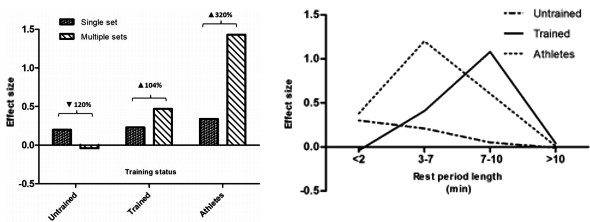
¡@¡@ÁºûÂ@ (2013) ¬ã¨s¦b¤£¦P²Õ¶¡¥ð®§®É¶¡ (¥ß§Y¡B3¤ÀÄÁ¡B7¤ÀÄÁ¡B10¤ÀÄÁ)¡A¬O§_¯à²£¥Í PAP ²{¶H´£¤É¹B°Êªí²{¡A¹ï¶H¬°30 ¦Wªý¤O°V½m¸gÅç1 ¦~¥H¤W¹B°Ê­û (25 ¨k»P5 ¤k)¡A¬yµ{¬°¥ý¶i¦æ3 ¦¸*65% 1RM ¡B2 ¦¸*75% 1RM ¡B1 ¦¸*85% 1RM ¥bÃÛÁ|«á¡A¦b¥ß§Y¡B3 ¤ÀÄÁ¡B7 ¤ÀÄÁ¡B10 ¤ÀÄÁ¥|­Ó®É¶¡ÂI¤À§O¶i¦æ««ª½¸õ´úÅç¡Cµ²ªGÅã¥Ü««ª½¸õ°Ñ¼Æ¬ÒµLÅãµÛ¼W¶iªí²{ (¥u¦³27%¨ü¸ÕªÌ±q¤¤±o¨ì®Ä¯q)¡A©Ò¥HPAP²{¶H¹ï©ó¸õÅDªí²{ªº¼vÅT¡A¦ü¥G¦³¨ü¸ÕªÌªº­Ó§O®t²§¡CWilson µ¥ (2013) ¤ÀªR32½gPAP ¬ÛÃö¬ã¨s¡A±À½×PAP´£¤ÉÀH«áÃzµo¤Oªº¼vÅTÅܶµ¡A©Ê§O¤§¶¡¨S¦³ÅãµÛ®t²§¡A¤¤µ¥±j«×­t²ü (60-84¢H 1RM) ¤ñ°ª±j«× (85¢H 1RM) ¦³§ó¦nªºPAP®Ä¯q¡A¦h²Õ¼Æ¤ñ³æ²ÕªºPAP®ÄªG§ó¦n¡A³Ì¾A·íªº²Õ¶¡¥ð®§®É¶¡¬°3-10¤ÀÄÁ¡C¥¼¸g°V½mªÌ«h¤£©ö¥X²{PAP®ÄÀ³ (¤U¹Ï)¡C

¹B°Ê¥Í²z¶g°T²Ä332´Á ¬¡¤Æ«á¼W¯q²{¶H (post activation potentiation, PAP)
¨ü¸ÕªÌªº®t²§¹ïPAP²{¶Hªº¼vÅT (Wilsonµ¥¡A2013)

¡@¡@³y¦¨ PAP ²{¶Hªº­ì¦]¦³¨âºØ¡A¨ä¤@¬O¹B°Ê³æ¤¸°ª¬¡¤Æ²v¡A¦b°ª­t²üªºªý¤O«á¡A³y¦¨H¤Ï®g (H-reflex)¡A«P¨Ï£\¹B°Ê¯«¸g¤¸ (£\ motor neuron) ¿³¾Ä¡A¶i¦Ó¬¡¤Æ§ó¦hªº¹B°Ê³æ¦ì¡A»¤µoPAP ²{¶H¡C¨ä¤G¬O¦Ù²y³J¥Õ»´Ãì¿E酶¼W¥[¿³¾Ä¦¬ÁY°¸³s (excitation contraction coupling)¡A·í¦Ù¦×¦¬ÁY®É¡A¦Ù¼ßºô (sarcoplasmic reticulum) ÄÀ¥X¶tÂ÷¤l¡A¬¡¤Æ¦Ù²y³J¥Õ»´Ãì¿E酶¡A«P¨Ï¦Ù°Ê³J¥Õ- ¦Ù²y³J¥Õ¬Û¤¬§@¥Î (actin-myosin interaction) §ó¥[±Ó¾U¡A´£¤É¾î¾ô (cross-bridge) ³sµ²ªº³t²v¡A¼W¥[ÀH«á¦Ù¦×ªº¦¬ÁY¤O¶q (Tillin & Bishop, 2009)¡C

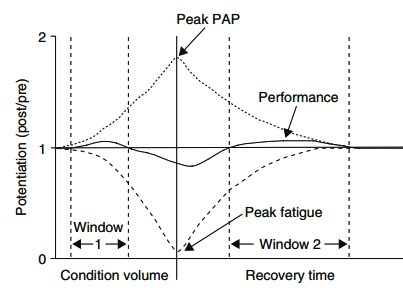
¹B°Ê¥Í²z¶g°T²Ä332´Á ¬¡¤Æ«á¼W¯q²{¶H (post activation potentiation, PAP)¡@¡@Tillin and Bishop (2009) ªº¤å³¹¤¤´£¨ì PAP»P¯h³Ò¹ïÃzµo¤Oªí²{ªº¼vÅT¡A¥k¹Ï¬°°V½m³B²z«áPAP©M¯h³Ò¹ïÃzµo¤Oªí²{ªº¬ÛÃö°²³]¡C¦bwindow 1 ¤¤¡A·í°V½m¶q§C®ÉPAP¹ïÃzµo¤Oªí²{ªº¼vÅT°ª©ó¯h³Ò¡A¦]¦¹ÀH«áªºÃzµo¤Oªí²{³Q¼W±j¡A¦ýÀHµÛ°V½mªº¶q¼W¥[¡A¯h³ÒÅܦ¨¥D­nªº¼vÅT¦]¯À¡A¹ïÀH«áªºÃzµo¤Oªí²{²£¥Í­t­±ªº¼vÅT¡C¦b«ì´_´Áªºªì´Á¡A¯h³Ò¤ñPAP¹ïÃzµo¤Oªí²{¦³¸û¤jªº¼vÅT¤O¡A¦]¦¹­°§C©ÎµLªk§ïµ½¹B°Êªí²{¡C¦ý¯h³Òªº®ø°£³t«×¤ñPAP§Ö¡A¦]¦¹¦b«ì´_´Áªº¬Y¤@­Ó®É¨è·|¥X²{«áÄòÃzµo¤Oªí²{ªº¼W±j²{¹³(window 2)¡CTillin and Bishop (2009) ªº±´°Q¤]µo²{¡A¦³¤@¨Ç¬ã¨s»{¬°¦b±Ä¥ÎPAP¨Ó¼W±jÃzµo¤Oªí²{®É¨Ã¤£»Ý­n«ì´_´Á¡A¦³¨Ç¬ã¨s¬Æ¦Üµo²{«ì´_´ÁªºÃzµo¤Oªí²{­°§C©Î¤£ÅÜ¡CPAP©M¯h³Ò¹ï«áÄòÃzµo¤Oªí²{ªº¬ÛÃö¼vÅT¬O¦h¦]¤lªº¥æ¤¬¼vÅT¡A¥]¬A¦¬ÁY°V½m (conditioning contraction) ªº¶q (²Õ¼Æ¡B¤ÏÂЦ¸¼Æ¡B²Õ¶¡¥ð®§ªº®É¶¡...µ¥)¡B±j«×¡B«¬¦¡¡B¹B°Ê­ûªº¯S½è (¦Ù¦×±j«×¡B¦ÙÅÖºû«¬ºA¡B°V½mµ{«×...µ¥) ¥H¤ÎÀH«á¹B°Êªí²{ªº°Ê§@«¬¦¡µ¥¡C

¡@¡@¦b¹B°Ê«e¡A¶i¦æ±M¶µ¼ö¨­°V½m«á¡A²£¥ÍPAP²{¶H¡A¥i¥H¼W¥[¦Ù¦×ªº¦¬ÁY¤O¶q¡A²£¥Í§ó¤jªºÃzµo¤O¡C¦]¦¹¹B°Ê­û¥i¥H³z¹L¹w¥ý¬¡¤Æ¥D­n¦Ù¸sªº¬¡°Ê»P°V½m¡A¼W¶iÀH«á¥D­n¬¡°Ê¤§¦Ù¦×¤O¶q¡A¶i¦Ó´£°ªÃzµo©Ê¹B°Êªºªí²{¡C¦ý¬O¡A°V½m¸gÅç¡B¹w¥ý¬¡°Êªº¹B°Ê±j«×»P«¬ºA (³æ¤@©Î¦h²Õ)¡B¹w¥ý¬¡°Ê»P¥D­n¬¡°Êªº¶¡¹j®É¶¡¡B...µ¥¡A³£¥i¯à¼vÅTPAPªº®Ä¯q¡C

¤Þ¥Î¤åÄm

ÁºûÂ@ (2013)¡C¬¡¤Æ«á¼W¯q²{¶H¤£¦P²Õ¶¡¥ð®§¶¥¬q¹ï¸õÅD§Y®Éªí²{¤§¼vÅT¡C¥¼¥Xª©ºÓ¤h½×¤å¡A°ê¥ß»OÆW®v½d¤j¾Ç¡A¥x¥_¥«¡C

Sale, D. G. (2004). Postactivation potentiation: role in performance. British Journal of Sports Medicine, 38(4), 386-387.

Smilios, I., Pilliandis, T., Sotiropoulos, K., Antonakis, M., & Tokmakidis, S, P. (2005). Short-term effects of selected exercise and load in contrast training on vertical jump performance. Journal of Strength & Conditioning Research, 19(1), 135-139.

Terzis, G., Karampatsos, G., Kyriazis, T., Kavouras, S. A., & Georgiadis, G. (2012). Acute effects of countermovement jumping and sprinting on shot put performance. The Journal of Strength & Conditioning Research, 26(3), 684-690.

Tillin, N, A., & Bishop, D. (2009). Factors modulating post-activation potentiation and its effect on performance of subsequent explosive activities. Journal of Sports Medicine, 39, 147-166.

Walker, S., Ahtiainen, J. P., & Hakkinen, K. (2010). Acute neuromuscular and hormonal responses during contrast loading: effect of 11 weeks of contrast training. Scandinavian Journal of Medicine & Science in Sports, 20(2), 226-234.

Wilson, J. M., Duncan, N. M., Marin, P. J., Brown, L. E., Loenneke, J. P., Wilson, S. M., ... Ugrinowitsch, C. (2013). Meta-analysis of postactivation potentiation and power: effects of conditioning activity, volume, gender, rest periods, and training status. The Journal of Strength & Conditioning Research, 27(3), 854-859.

¡@¦@¦³ 3 ¦^À³

¦^À³ : 1 epsport®É¶¡ : 2026/2/4 ¤U¤È 10:46:42 From : 114.40.196.77

Front. Physiol. 10:1359. doi: 10.3389/fphys.2019.01359
Post-activation Potentiation Versus Post-activation Performance Enhancement in Humans: Historical Perspective, Underlying Mechanisms, and Current Issues

Anthony J. Blazevich1* and Nicolas Babault2
1 School of Medical and Health Science, Centre for Exercise and Sports Science Research (CESSR), Edith Cowan University, Joondalup, WA, Australia, 2 Faculty of Sport Sciences, French National Institute of Health and Medical Research (INSERM), Unit 1093 Cognition, Action and Sensorimotor Plasticity, Centre for Performance Expertise, University of Burgundy and Franche-Comté, Dijon, France

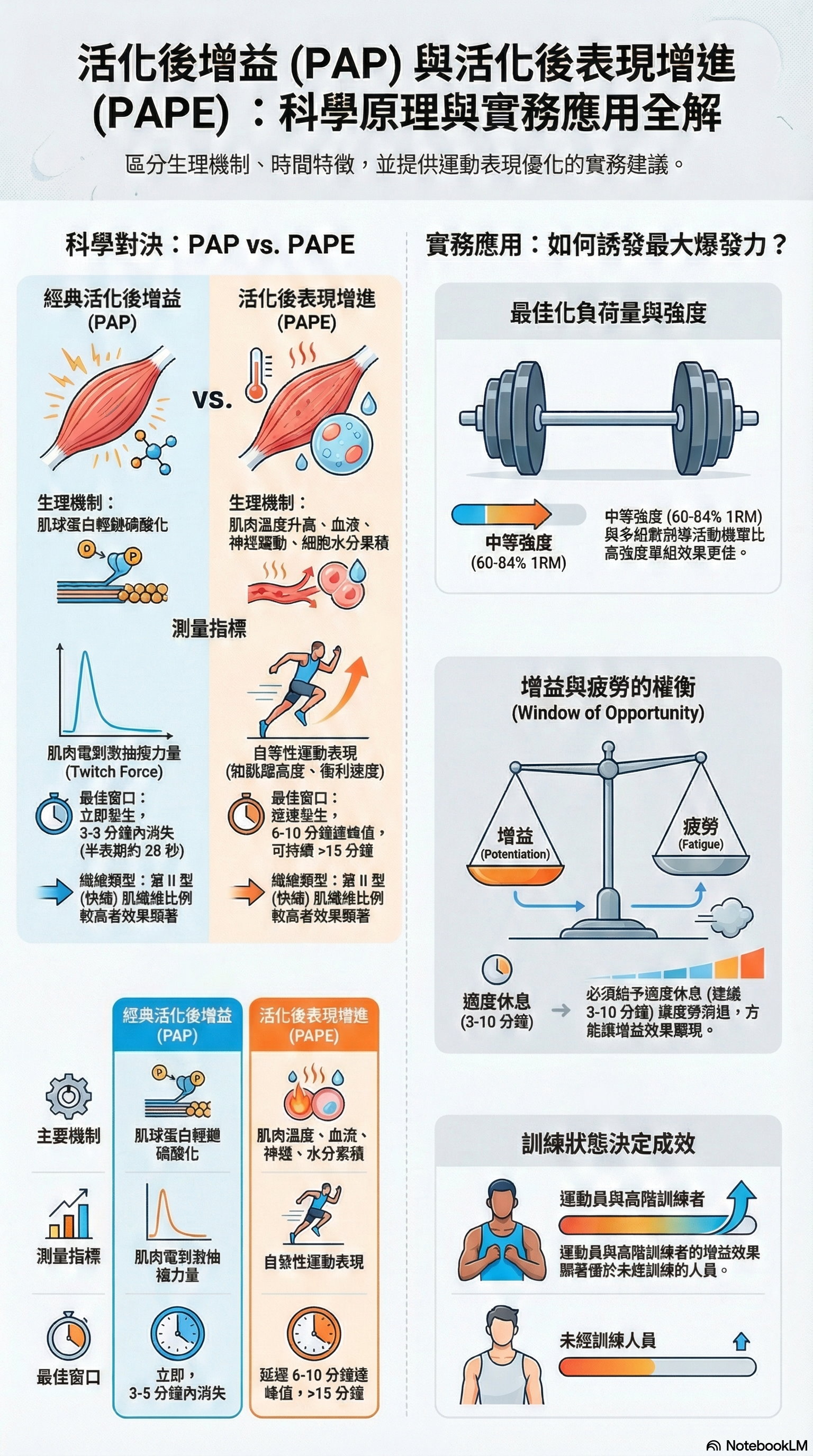
Post-activation potentiation (PAP) is a well-described phenomenon with a short half-life (~28 s) that enhances muscle force production at submaximal levels of calcium saturation (i.e., submaximal levels of muscle activation). It has been largely explained by an increased myosin light chain phosphorylation occurring in type II muscle fibers, and its effects have been quantified in humans by measuring muscle twitch force responses to a bout of muscular activity. However, enhancements in (sometimes maximal) voluntary force production detected several minutes after high-intensity muscle contractions are also observed, which are also most prominent in muscles with a high proportion of type II fibers. This effect has been considered to reflect PAP. Nonetheless, the time course of myosin light chain phosphorylation (underpinning ¡§classic¡¨ PAP) rarely matches that of voluntary force enhancement and, unlike PAP, changes in muscle temperature, muscle/cellular water content, and muscle activation may at least partly underpin voluntary force enhancement; this enhancement has thus recently been called post-activation performance enhancement (PAPE) to distinguish it from ¡§classical¡¨ PAP. In fact, since PAPE is often undetectable at time points where PAP is maximal (or substantial), some researchers have questioned whether PAP contributes to PAPE under most conditions in vivo in humans. Equally, minimal evidence has been presented that PAP is of significant practical importance in cases where multiple physiological processes have already been upregulated by a preceding, comprehensive, active muscle warm-up. Given that confusion exists with respect to the mechanisms leading to acute enhancement of both electrically evoked (twitch force; PAP) and voluntary (PAPE) muscle function in humans after acute muscle activity, the first purpose of the present narrative review is to recount the history of PAP/PAPE research to locate definitions and determine whether they are the same phenomena. To further investigate the possibility of these phenomena being distinct as well as to better understand their potential functional benefits, possible mechanisms underpinning their effects will be examined in detail. Finally, research design issues will be addressed which might contribute to confusion relating to PAP/PAPE effects, before the contexts in which these phenomena may (or may not) benefit voluntary muscle function are considered.


¦^À³ : 2 epsport®É¶¡ : 2026/2/4 ¤U¤È 10:49:18 From : 114.40.196.77

±´°Q¬¡¤Æ«á¼W¯q²{¶H¡]PAP¡^¤Î¨ä­l¥Í·§©À¬¡¤Æ«áªí²{¼W±j¡]PAPE¡^¹ï¦Ù¦×®Ä¯àªº¼vÅT¡CPAP ¥D­n·½©ó¦Ù²y³J¥Õ»´ÃìÁC»Ä¤Æ¡A¯àµu¼È´£¤É¦Ù¦×¹ï¶tÂ÷¤lªº±Ó·P«×¡A¦ý¨ä®ÄªG³q±`¦b¼Æ¤ÀÄÁ¤º¨³³t®ø°h¡C¬Û¸û¤§¤U¡APAPE «üªº¬O¦b°ª±j«×¹B°Ê«á¡A¦]Åé·Å¤É°ª¡B¦Ù¦×¤ô¤À²Ö¿n©Î¯«¸gÅX°Ê¼W±j¡A¨Ï¦Ûµo©Ê¹B°Êªí²{¦b¸ûªø®É¶¡¡]¬ù 6 ¦Ü 10 ¤ÀÄÁ¡^«áÀò±o´£¤É¡C¬ã¨s«ü¥X¡A³oÃþ²{¶H¦b°V½m¦³¯Àªº¹B°Ê­û»P¨ã¦³°ª¤ñ¨Ò§ÖÁY¦ÙÅÖºûªº¤H¸s¤¤§ó¬°ÅãµÛ¡A¥B¨ü¨ì¹B°Ê­t²ü¡B²Õ¼Æ»P¥ð®§®É¶¡ªººë±K¼vÅT¡C¬°¤FÀu¤ÆÃzµo¤Oªí²{¡A¹ê°È¤W«ØÄ³±Ä¥Î¤¤°ª±j«×¡]60-84% 1RM¡^ªº½Õ¸`¬¡°Ê¡A¨Ã»Ý¥­¿Å¼W¯q®ÄªG»PÀH¤§¦Ó¨Óªº¦Ù¦×¯h³Ò¡C¾ãÅé¦Ó¨¥¡A°Ï¤À¨âªÌ¾÷¨î¦³§U©ó¹B°Ê¬ì¾Ç»PÁ{§É´_°·°w¹ï¤£¦P»Ý¨D¨î©w§ó¦³®Äªº¼ö¨­»P°V½mµ¦²¤¡C


¦^À³ : 3 epsport®É¶¡ : 2026/2/4 ¤U¤È 11:20:31 From : 114.40.196.77


¡@¡@¦^¤W­¶ ¡@¡@µoªí¦^À³
 B ʥͲz Ǻ
 B ʥͲz Ǻ     Ǥƶ] B V m
 B ʥͲz Ǻ    x W   a V m A ȥ  x
 B ʥͲz Ǻ      Z w   P V m B
    (PFQ) [ c
 B ʥͲz Ǻ    C ֦~    פ  R
 B ʥͲz Ǻ   YouTube W D
°·±d¹B°Êªº¤èªk»P«O°·

epsport-ad

 j M     ҾǥZ

¹B°Ê¥Í²z¾Çºô¯¸
¹B°Ê¬ì¾Ç±Ð¨|¬ã¨s«Ç